
The Eldin Tycaum
Codex Pryango: The Official Riftworlds Glossary
A Note on the Elements and Riftmage Mutations: Two Eldin scholars alive at the height of the Eldin Empire near the end of the First Age compiled much of what the ancient world knew about rift elements and the mutations they caused into a single tome. Anders Bödæč was born in the north of Öllerá. He eventually found his way to the Eldin Tycaum in Old Albria, rising to become the age’s foremost alchemist. His rival, Sala Rihl, became one of the Tycaum’s most feared battle mages. She was rumored to be the first and only Eldin to master each of the thirteen major elements.
Together, they began compiling the Codex Pryango to condense and preserve the Tycaum’s body of knowledge before the war laid waste to their empire. Compiled here is an abridged glossary of what survived in those pages, alongside additions from Tamlin Tiin’s Cosmography and Histories of the Empires of Albria.
Eldinian Pronunciation Guide
á: aw—as in paw
æ: ae—as in aesthetic
č: ch—as in check
ę: aa—as in man
gh: silent gh—as in dough
į: ee—as in meet
j: y—as in yacht
ó: oh—as in no
ö: oo—as in loot
ø: silent th—as in asthma
q: k—as in keep
r: rː—as in perro
š: sh—as in sheep
ž: s—as in pleasure
-
Both an ethnic group and a religion. The Abotenar resisted the Albrian Empire’s rise to power during the second age and were persecuted during the Emmon Crusades. The Abotenar were the main targets of the Emmon Crusades.
-
Commonly referred to as the Acolytes. A dominant religion across Albria that rose to power early in the Second Age and gained influence and control across many kingdoms and groups of the Trade Sea.
-
The first age to be counted. Largely a period marked by the rule of the Eldin Empire and lasted roughly 1296 years.
-
The Second Age started at the end of the Eldin Dynasty and lasted 792 years till the Rift.
-
The current age. The Third Age began at the Rift that marked the end of the Albrian Empire. The current year is 189 of the Third Age.
-
Scholars use the name to refer to their world, but mystics and minstrels say that Agnón is one of the eight mythic realms. Agnón translates to those who drive with force.
-
The southeastern continent bordering the Trade Sea. Once the home of the Eldin and Albrian Empires. Now largely abandoned since the Rift decimated the Albrian Empire at the end of the Second Age. Commonly referred to as the Continent.
-
A large boggy plain between the Talón and Váltmav Mountains. Though teaming with rift mutagens and home to the largest rockwyrms on the Continent, Andoline bog water is revered for its alchemical properties.
-
A scrying wand that’s prepared by pouring molten psiglass atop two adjacent portions of a bog ash limb. Can be used by two psipaths to form a nearly undetectable psipathic link, allowing them to share thoughts and perception across great distances. Ranks a 2 on Bödæč’s Scale.
-
A relative term used to denote the middle third of the riftmage arts.
-
A relative term used to denote the upper third of the riftmage arts.
-
A relative term used to denote the lower third of the riftmage arts.
-
One of the thirteen Eldin Elements that the Eldin Portals were supposedly made from. Exposure induces a coma that victims waste away in before ever waking up. On Bödæč’s Scale, ranks a 9.
-
A diffuse glow of rift energy that leaks from rift minerals and riftmages. This is the light that shadowmancers sense and the light source that those who’ve drunk sal aura can see by.
-
Indigo and emerald aurora that emanates from the rift storms on Albria. The ancient lore suggests that áromancers once wielded rift aurora.
-
The fabled Silk Assassins of the Ásmav Mountains. The Thirteen Ghosts were said to be the first Ælqmu Ešešiv. See also Silk Assassins and The Thirteen.
-
A large forest lizard of similar length to rockwyrms but considerably lighter and faster on the ground. The back of barkwyrms is covered in bark-like armor. They often reach upwards of twenty feet in length and can weigh up to 1,800 pounds.
-
A riftmage who’s mutated off either ink of rifted a squid or riftbar. Beguilers can force a trace amount of their riftbar through their sweat pores, and by touching a subject, they’re likely to gain psipathic empathy and influence over that individual. Minor beguiling is a general art.
-
The macerated remains of dream ash limbs that fall into a bog. Rifted ash trees commonly grow in and around rift bogs. Andoline bog ash ranks a 5 on Bödæč’s Scale, while Vaslin bog ash ranks a 3.
-
When water collects around rift elements, the water absorbs portions of the energy, taking on the properties of those elements. Each rifted biome produces unique bog water relative to the elements, minerals, flora, and fauna there. Each bog ranks differently on Bödæč’s Scale, relative to the rift elements present in the mire.
-
Commonly referred to as Bödæč’s Scale. A contested but relevant way of ranking the rift elements relative to one another. The scale starts with knack elements—the lowest in energy exposures that result in riftmage mutation, moves to minor elements, then general elements, and ends with the major elements, which commonly require years of dedicated study, preparation, and graduated exposures for riftmages to survive.
-
An Eldinian curse word.
-
One of the eight mythic realms. Home of the greatest inventors the realms have seen. Cyros translates to those of us who journey.
-
A superstitious term, used by the uninitiated for shadowmancers and silk masters.
-
A rifted species of massive black oak. The heartwood is prized by weapon smiths for its long, straight grain, and the sap is fermented by Druveyds for shamanistic brews. On Bödæč’s Scale, the wood ranks a 5, and the sap ranks a 7.
-
An ancient order of alchemists that rose to power in the first age. They remained neutral during the end of the Eldin Empire, but were infiltrated by the Acolytes near the year 600 during the Second Age. Dágdin translates to those who build within.
-
A powerful island kingdom at the western edge of the Trade Sea. Once a minor Albrian trade port, it’s become a major player within the politics of the Trade Sea, as it’s the home port of the Guild of Mercers.
-
A broad and lazy river valley, through which the Southern Drake flows on its way to the East Sea. The Upper Drake flows due south from the southern Ásmavs. When it reaches central Albria, it hooks to the east and winds through the Drake River Valley. This valley is one of the more fertile areas on the continent.
-
A large clade of scaled lizard-like riftlings that are efficient at adapting to new biomes. Though believed to be native to the Realm Dráqón, they inhabit many realms, including Agnón, Telægos, Möir, and the Rift. Dráqon translates to those with light within.
-
A knack element, far from common on Agnón. Both mundane gold and dráqón gold are used by alchemists to encase dangerous rift elements prior to transport since they’re malleable and shield rift energy. Dráqón gold’s better at shielding than mundane gold.
-
A honey wine made with honey collected from rift herbs and flowers, and used as the base alcohol for physomancy brews. A common drink for riftmages in the north.
-
One of the eight mythic realms. Said to be home to a myriad dráqon species, ancient ruins, and sprawling jungles. Dráqón translates to those who lead with light.
-
A turnip wine made from a rare species of turnips that grows at high elevations in the Ásmav Mountains. Unfermented, dráqón turnips are toxic and used to make poisons. While the fermented variety ranks a 3 on Bödæč’s Scale, raw dráqón turnips rank a 6.
-
A pair of inland seas on the continent of Albria that feed to the north and into the Trade Sea. The ruins of Old Eldin are on the southeastern shore of the Major Dread Sea. The Dread Seas are known as being the most rifted waters of the realm, home to all manner of dangerous sea beasts.
-
Superstitious folk often refer to psinox as a dreamwitch. A dreamwitch can project their consciousness into the Dreamscape while they sleep or meditate.
-
A riftmage who studies the botanical lore and rift herbalism. Druveyds became exceedingly rare after the Emmon Crusades. Druveyd translates to those with a strong truth.
-
One of the nations of the First Age and a principal empire of that time. The Eldin were the first people to master the higher arts. Most of the rift lore that survives to the present came from the Eldins.
-
A powerful painkiller that doesn’t cause delirium or loss of dexterity. It is, however, highly addictive and causes blissful dreams once asleep. Many people suffering from night terrors get addicted to it. On Bödæč’s Scale, ranks a 3.
-
The ruins of the Albrian and Eldin Empire on the southeastern coast of the Major Dread Sea. Also referred to as the Eldin Ruins.
-
The language of the Eldin. Considered by most to be a dead language, as it’s forbidden in acolyte-controlled territories.
-
The nomadic people of the Lipimqæló Desert. Since the Rift, they’ve greatly expanded their range and can be found throughout most of Albria. While the Eldveyd have little formality in how they train riftmages, they are powerful but reclusive. Eldveyd translates to those who see beyond.
-
In lore, the most powerful rift elements are collectively referred to as the major elements. An Eldi was a riftmage who mastered at least one of the thirteen Eldin Elements.
-
Eldrigite is most commonly used as a focus talisman, through which a psipath expands their perceptive abilities. Major psipaths can distort an opponent’s awareness of their position, actions, and intent. Eldrigite is a knack element.
-
A hundred-year war near the end of the Second Age, between the Albrian Empire and the Abotenar people. Though commonly believed to start with an assassination attempt on the emperor, there are those in Öllerá who believe it was a genocide of the Abotenar people.
-
Though fire agate is considered a nearly mundane element, the gas trapped inside the rock’s numerous crystalline bubbles is a powerful hallucinogen. The gas is lighter than air and nonflammable. On Bödæč’s Scale, the rock is a knack element, but the gas ranks a 3.
-
While fire jade is considered unsurvivable, extract of fire jade is used to produce a pyromancer. On Bödæč’s Scale, processed fire jade ranks a 5, but raw fire jade is off the chart.
-
A potent physomancer brew, made from the honey collected during the frost crocus blooms of Öllerá. The old barbarian warriors of the north drank frost ale prior to battle to induce a frenzied rage where they hardly bled. On Bödæč’s Scale, ranks an 8.
-
Also called Vine Wyrms. One of the more common dráqon species on the Continent. The Eldin elites used them to hunt in a similar way to how falcons are used. Green Drakelings are small, with a body similar in size to a lynx.
-
An old merchant guild that was powerful during the Second Age, but quickly secured a trade monopoly after the Rift of trade coming off the Continent. The Guild of Mercers is closely associated with the Acolytes of the Flame Eternal.
-
A solid metal under normal conditions, but is psipathically malleable by psmiths. Hardsilver is liquid, while the psmith is focused and retains its shape once they break contact or lose focus. On Bödæč’s Scale, hardsilver ranks a 2.
-
Seven mythic keys, many of which are thought to be lost. The Eldin Keys are believed to have been forged during the first age. They’re round pendants made up of various rift metals, each resembling a winding knot maze, but differing in composition. Any one of the keys is said to open the Lost Archives in Old Eldin. Additionally, two keys are said to activate the ancient Eldin Portals.
-
A bright silvery medallion made from minor árorite and næghad steel. At the center, set inside the four inner corners of the maze, is a large Ážrerite gem about the size of an acorn. Ážre translates to goddess of dawn. Key Bödæč’s: 8. Set Stone Bödæč’s: 10.
-
A bright white medallion made from árorite, voidarite, and næghad steel. At the center, set inside the four inner corners of the maze, is a large atratite gem about the size of an acorn. Key Bödæč’s: 9. Set Stone Bödæč’s: 9.
-
A brownish medallion with dull patina made from voidarite, shieldrite, and næghad steel. At the center, set inside the four inner corners of the maze, is a chunk of heartstone rock about the size of an acorn. Key Bödæč’s: 9. Set Stone Bödæč’s: 9.
-
A mercurial blue medallion made of squall iron and næghad steel. At the center, set inside the four inner corners of the maze, is a large wave opal about the size of an acorn. Key Bödæč’s: 9. Set Stone Bödæč’s: 6.
-
A term used for both the lowest-ranked rift elements and a budding riftmage who has survived their initial exposure to a rift mutagen.
-
The last manned outpost on Talón Ridge held by the Nódán. This is their furthest east garrison.
-
A dangerous physomancer brew that only the Eldveyd know how to brew. Lizard tail mead is said to grant major physomancers the ability to regrow limbs. On Bödæč’s Scale, ranks a 7.
-
A lost library and rift element vault, hidden somewhere in the ruins of Old Eldin. Said to hold ancient tomes, rare elements critical for the higher arts, and a massive store of fire agate that the Albrian alchemists used as a non-flammable lifting gas for their airships.
-
A general term used to denote how advanced a riftmage is in a specific art or how powerful a rift element is relative to other elements. Major is a relative term. Thus, a major psipath is not as powerful as a major beguiler.
-
An old Eldinian term meaning one who imparts wisdom and was used for teachers or mentors.
-
A general term denoting how advanced a riftmage is within a specific art or how powerful a rift element is relative to other elements. Minor is a relative term. Thus, a minor psipath is not equal in power to a minor physomancer.
-
One of the eight mythic realms. Commonly referred to as the Lost Realm. Möir is mostly covered in water, with numerous island chains and archipelagos. Möir translates to large body of water.
-
Famed in lore, the Næghad Plain is a boggy swamp on Telægos. It is revered for many relics and druveydic knowledge. Scattered throughout the massive region are ancient groves that the Næghad people have tended since before time was recorded in that realm.
-
A dark, nearly black geode with dark iridescent inclusions. Once cracked open, the inside crystals are indigo. However, they oxidize rapidly, producing an intense invisible flame. Spectrolite forge goggles are worn by anyone working with nightfire, as the reaction will blind them. On Bödæč’s Scale, ranks a 1.
-
A potato liquor distilled over burning nightfire ore in rift copper stills. Thought to be a hallucinogen by mundane folk, nightshade is rather a nootropic alcohol that grants the subject minor aura sight; thus, they’re able to sense a soft glow of anything with rift energy when it’s dark. Nightshade is the knack element for Physomancers.
-
A loose faction of independent kingdoms and tribes on the continent of Öllerá that have given aid to each other since the Albrian Empire invaded during the second age.
-
An ancient order of knights who rebelled against the Eldin Emperor at the end of the First Age. During the Second Age, they were the right hand of the Albrian Empire until the latter years of the Emmon Crusades, when the order fractured. Other than the Eldveyd, they’re the only group that remained on the Continent post-rift and are currently politically independent. Nódán translates to those without a house.
-
The northern continent bordering the Trade Sea. Commonly referred to as the North. Öllerá is home to the ancient barbarian tribes of the region that repelled both the Albrian and Eldin Empires. Öllerá simply translates to the north.
-
The drunken wild cards of riftmages. Physomancers are very adaptable riftmages and often present as having the riftmage focus of whatever substances they’ve added to their brew. Assuming they have the foresight to drink the right brew, they’re capable of matching the abilities of many general riftmages. Physomancers often excel in melee fighting as the athletic boon of many of their brews is considerable.
-
Physomancy brews are used by physomancers to boost their physical, mental, and magical abilities. Most physomancy brews stem from dráqón mead or nightshade liquor with the addition of more powerful rift elements. For the uninitiated, they cause intense hangovers as well as other symptoms related to the adjuncts used in the given brew. Each brew ranks differently on Bödæč’s Scale, relative to its adjuncts.
-
Also referred to as secret breaker. A powerful substance that significantly lowers a subject’s inhibition to interrogation and psipathy. It’s toxic, even to strong riftmages, thus illegal in most countries. Pixy drop is made by macerating the red berries from the fairy thorn tree in nightshade liquor and aging the solution in psiačite glass. It’s an effective painkiller, but is only used as such for hospice purposes.
-
A riftmage who survived their initial exposure to a higher-level element than a knack. They tend to do well through the general arts, but unless they learn what they were initially exposed to, they often stall out before the major arts.
-
A rifted substance such as quicksilver, shieldrite, rifted silk, or Ážrerite that’s psipathically forged by the riftmage into tools or weapons or animated through psipathic telekinesis.
-
A blown glass with eldrigite and trace amounts of psiačite added, used as an aging vessel that heightens the effects of alchemicals, tinctures, and physomancer brews. Before glassblowing, earthenware vessels were made from psiačite clay, but this fell out of fashion due to psiačite’s toxicity. On Bödæč’s Scale, ranks a 2.
-
A precision muzzle-loading rifle that a Psniper uses—igniting the charge with their mind. Psilock, though the accepted term, is a misnomer since these rifles have no lock, flint, or trigger.
-
A riftmage who’s knacked off eldrigite. They study rift elements and abilities focused on mental fortitude, perception, mental protection, and, eventually, telepathic abilities. Psipathy is a critical area of study for all riftmages, though few master it.
-
A psipathically forged ball of psmith’s tungsten and the primary weapon of the minor psiqin. Unlike psmiths, psiqin can telekinetically manipulate their psmith’s tungsten. When thrown, psishot orbs are accelerated through psipathy and can reach significant velocities.
-
A riftmage who’s mutated off amalgam of psmith’s tungsten. They study the art of psipathically wielding weapons containing psmith’s tungsten. If the bond is strong enough to a given weapon, they’ll be able to manipulate it without contact. Minor psiqin magic is a general art.
-
A riftmage who’s knacked off quicksilver. They study the ability to psipathically forge rift elements such as quicksilver and hardsilver. As fighters, they tend to rely on martial prowess with quicksilver and hardsilver weapons. As craftsmen, their focus is on the foundry and forge, advancing the alchemical arts by bonding numerous rift elements to rift metals. Psmithing is a minor art.
-
Minor psiqin mutate off psmith’s tungsten, which is a synthesized amalgam of nebular alloy, derived in an alchemical laboratory rather than mined from the exceedingly rare void stone. It’s not as caustic as shieldrite and only produces a minor psiqin. On Bödæč’s Scale, ranks a 5.
-
A psniper is a pyromancer marksman who uses psipathy to ignite their powder charge. As they don’t need a mechanical lock and trigger, they tend to be more accurate. See also psilock and pyromancer.
-
Pryango stone psmiths used an advanced form of stone psmithing to soften and psipathically forge rock. How they achieved this was lost during the Rift. Pryango masonry is often distinguished by the seamless, monolithic form of its supports, arches, curtain walls, and battlements.
-
One of the eight mythic realms. Little lore is known about Prymos as it’s mentioned only in passing in the old sagas. Prymos translates to the first us.
-
A riftmage who’s survived exposure to ash of fire jade and studies psipathic combustion. Pyromancers ignite flammable substances that they’ve studied through psipathy, and the best can manipulate the burn rate of an enemy’s gunpowder to affect projectile velocity. Most psniper mix their own gunpowder and keep the composition secret. Pyromancy is a general art.
-
A massive jawless fish with a circular row of teeth that’s believed to be a rift-mutated lamprey. Though bottom feeders, they’re occasionally spotted hunting near the surface of the Dread Seas and Bone Shoals and are attributed to sinking small craft.
-
An infamous spy guild from Öllerá known for their advanced knowledge of rift elements and cunning subterfuge.
-
A liquid metal under normal conditions and the knack element for psmiths. After a psmith cross-exposure with eldrigite, they can psipathically forge quicksilver into tools and weapons. Quicksilver only stays in its intended form as long as the psmith is focused and in contact with it.
-
An Eldinian term that means initiate or student.
-
Any element, herb, or entity that imbues a subject with rift energy when they’re exposed to it. Rift elements are classified by both the type of mutation they cause and by their relative energy. See also Bödæč’s Scale of Potency.
-
A sickness caused by exposure to the parasites in rifted bog water and the bites and stings of many minor riftlings such as murk bellies, carapace rats, and pixy wasps. Rift lung is predominantly a threat to mundane folk. Boiling water kills the parasites, as does adding alcohol. Chunks of dráqón gold can be added to the water to neutralize the rift energy they hold.
-
Thought to be a communicable sickness experienced by mundane folk. Except in rare instances, rift plagues are often the result of a rift element contaminating a water or food source.
-
A strong psipathic element, used by beguilers to influence and even control weaker psipaths. Riftbar is more common than riftbar amalgam, which major beguilers use. On Bödæč’s Scale, ranks a 6.
-
Any rifted animal, whether it flies, scurries, burrows, or swims. From the numerous dráqon to the smallest insects, riftlings are commonly dangerous. Bites and stings from many rift-adapted creatures, such as carapace rats, often serve as vectors for rift plagues. Exposure to the breath energy of many dráqon riftlings is a general to major exposure.
-
Large water dráqon, most closely resembling a crocodile. Rockwyrms generally live in rift bogs but have been known to adapt to rifted aquatic biomes, be it river, brackish, or saltwater. Mature rockwyrms have rift crystals growing on their backs that are unique to their bog and provide considerable armor. They’re large, often reaching twenty to thirty feet in length, and can weigh upwards of 3,000 pounds. They burp indigo fire.
-
A large water-borne dráqon, about the size of a humpback whale. Sapphrins, like green drakelings, have existed on Agnón since the Eldin Empire. The lore suggests that the Eldin trained them to guard their fleets. They were hunted to near extinction during the Second Age, but have been coming back since the Rift. What’s more, they seem to thrive in the rifted waters of the Dread Seas, and they’re growing larger.
-
A tincture of ground spectrolite dissolved in nightshade liquor and aged in psiglass. Sal aura enhances night sight by allowing those who consume it the ability to see aura, thus making stronger auras a source of invisible light. On Bödæč’s Scale, it generally ranks a 4, but concentrates can rank much higher.
-
A riftmage who’s mutated off wave opal and can breathe underwater. The art of the saltwitch is a general art.
-
One of the eight mythic realms—also referred to as the Shadow Realm and the Rift. Scáøqæló translates to the shadow wastes.
-
A riftmage who’s survived exposure to specter’s breath, which produces intense burns and, in extreme cases, grants aura sight without needing to drink sal aura. The iris of the riftmage’s eyes will develop an indigo halo around the pupil. Regular sunlight, however, becomes very intense.
-
A painkiller that causes blissful inebriation. Often used in healing wards for riftmages with significant trauma. Unlike Eldin Red, it’s not addictive. It’s made from distilling shadow eel venom. On Bödæč’s Scale, ranks a 3.
-
One of the thirteen Eldin Elements. Shadowrite is an extremely caustic and rare mineral. Trace amounts of it are found in nightfire ore, and it’s the suspected mutagen that gives specters their magic. Shadowrite makes a shadowmancer. On Bödæč’s Scale, ranks 9.
-
One of the thirteen Eldin Elements and the prerequisite for major psiqin. Major psiqin can expertly wield shieldrite weapons with their minds. On Bödæč’s Scale, ranks a 9.
-
A historic group of Eldi assassins steeped in superstition. Whether or not they’re still operating is debated. See also Ælqmu Ešešiv and The Thirteen.
-
The average length of a foot, measured by the Eldins, in the first age, equalling approximately ten inches.
-
The average length of a walking step, measured by the Eldins, in the first age, equalling approximately thirty inches.
-
A midsized species of dráqon that is native to the Rift. Specters are nocturnal and sightless, though they keenly sense rift aura. They hunt anything with a bit of magic. Specters can reach upwards of a thousand pounds. They’re said to breathe a concentrated version of the same energy released when nightfire oxidizes.
-
A minor element that’s soft and flaky. Its color is similar to peridot, but its composition is like mica. When a layer is peeled, the fresh surface oxidizes and produces a diffuse yellow-green light. Psipaths through focus can enhance this light. On Bödæč’s Scale, ranks a 1.
-
A large rifted wasp similar in size to a tarantula hawk with an intense, painful sting that causes temporary paralysis to the affected area. Spirefalc, though territorial, tend not to travel far from their nests. They feed on the carcasses of anything drowned in the bog and tend to nest near rockwyrm dams.
-
The distilled and psiglass-aged venom of spirefalc wasps. Used by rift surgeons as a paralytic and is the rumored active ingredient of the famed Eldin duelist’s blade, which causes paralysis to a limb when cut. On Bödæč’s Scale, ranks a 2.
-
A small winged water-borne dráqon that hunts in both ocean and fresh water. They’re a bit smaller than a dolphin, and can swim fast enough that when they jump out of the water, they are capable of gliding for some time.
-
An independent kingdom in the west of the northern continent of Öllerá. Tælenty has been at war with the Öllerán barbarian tribes since before they formed the Northern Alliance. Tælenty is currently allied to Donitai.
-
One of the eight mythic realms. Commonly referred to as the Bazaar. Telægos translates to the furthest realm.
-
Also referred to as The Thirteen Ghosts. In lore and the ancient ballads, the Thirteen were the right hand of the Eldin Emperor—warriors of mythical status and masters of the Eldin Elements. The Acolytes have long said that the Thirteen turned on the last Eldin Emperor and assassinated him. His wife, in her despair, cursed the Thirteen to haunt the Ásmav Mountains till the end of time.
-
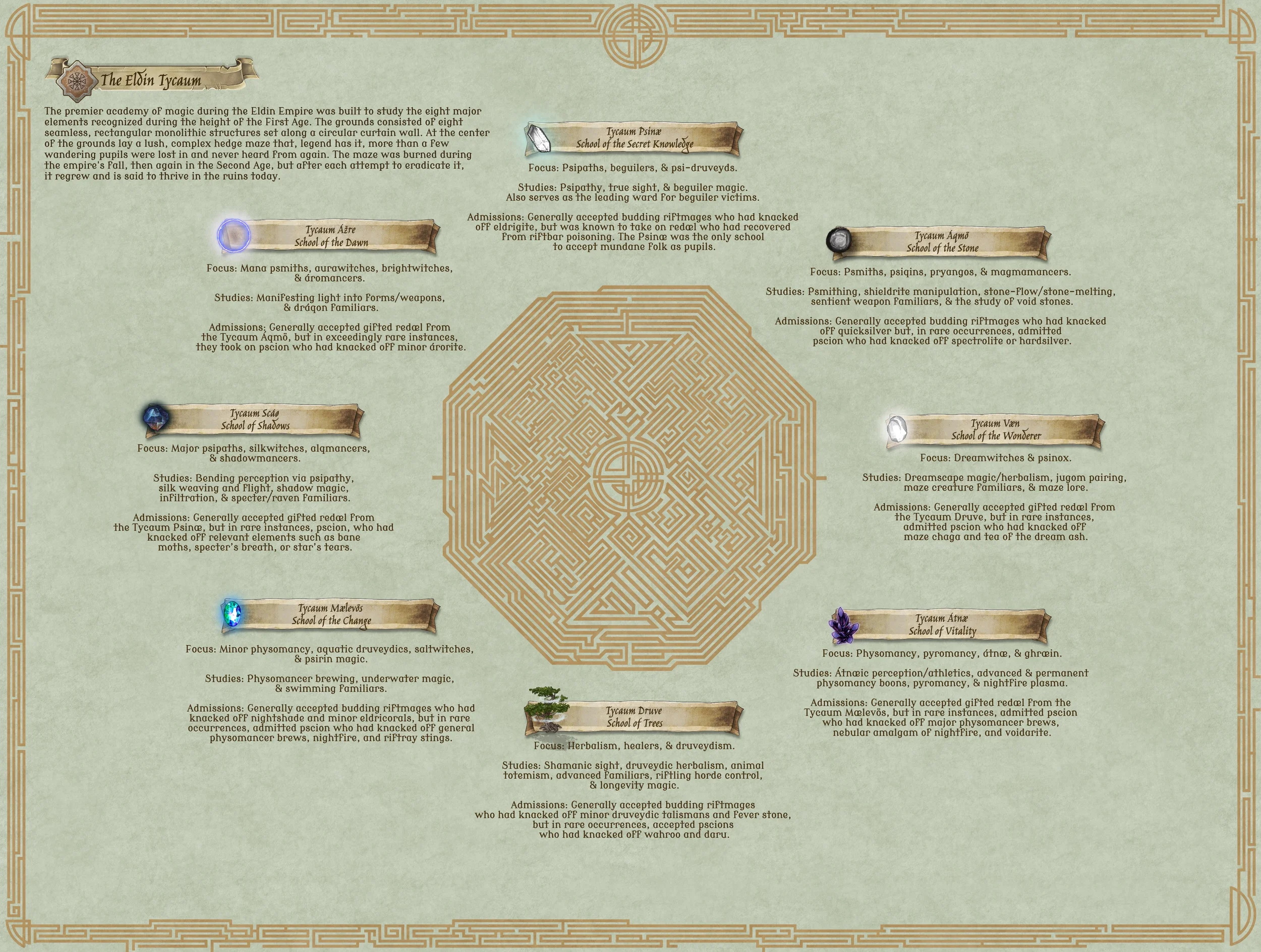
The once great academy of magic during the Eldin Empire. Each of the Tycaum’s eight schools were stationed in one of the rectangular monolithic structures found on the grounds. The minstrels say that at the height of the Tycaum’s power, the lush maze that filled the center grounds was so complex that more than a few pupils who wandered into the maze were never seen again. Despite several attempts to eradicate the maze during the Second Age, it regrew multiple times and thrives to this day.
-
The School of the Stone. One of the eight schools of the Eldin Tycaum—that trained psmiths, psiqins, pryangos, & magamamancers.
-
The School of the Dawn. One of the eight schools of the Eldin Tycaum—that trained mana psmiths, áromancers.
-
One of the eight mythic realms. Commonly referred to as the Dreamscape. Vændvált translates to the maze wilds.
-
A tricky rift element to master, voidarite is used to amplify a riftmage's magic and held similarly to eldrigite. On Bödæč’s Scale, ranks an 8.
-
A pearl formed by a rifted mollusk that, when properly prepared, grants the riftmage underwater breathing. Though wave opal is a general element, exposure to it has been known to kill relatively strong riftmages. On Bödæč’s Scale, it ranks a 6, though most modern scholars believe it should rank an 8.
-
A powerful minor element, used by riftmages as a stimulant and generally considered a requirement to become a physomancer. Wyrmstones grow on the back of rockwyrms. Wyrmstone brew is used by dissolving trace amounts of the crystals in nightshade. It’s often added as a casing to tobacco. On Bödæč’s Scale, ranks 4.